A late cancellation policy for yoga and Pilates studios, with a template
The four decisions behind a fair cancellation policy, a template you can copy, and how to apply it without having awkward conversations.

A late cancellation costs a small studio twice. The member does not come, and the spot they held could have gone to someone who would have. In a class of ten, two empty mats is a fifth of the room.
Most studio owners know they need a policy, and put it off because it feels strict. It does not have to be. A clear policy is mostly a kindness: members know where they stand, and you stop making a new judgement call every time someone writes at 07:10.
Why a written policy helps everyone
Without a written rule, every late cancellation becomes a negotiation. You decide case by case, members notice that you decided differently last time, and the conversation gets uncomfortable for both of you.
With a written rule, the decision is already made. You are not refusing anyone; you are pointing to something everybody agreed to when they booked. It also changes behaviour: when members know the cut-off, most of them cancel before it.
The four decisions to make
1. The window: how late is late?
This is the number of hours before class after which a cancellation counts as late. There is no single right answer, but a few patterns are common:
- 12 hours for regular mat classes, yoga and group fitness. Long enough for a waitlisted member to plan around it, short enough not to feel harsh.
- 24 hours for small-group or equipment-based classes, such as reformer Pilates, where each spot is scarce.
- Early-morning classes are worth thinking about separately. A 12-hour window for a 07:00 class ends at 19:00 the evening before, which members may not expect. Say so clearly.
Pick one window for the whole studio if you can. One rule is easier to remember than three.

2. The consequence: what actually happens?
The consequence should be proportionate and simple to apply. The usual options:
| Consequence | Works well for | Watch out for |
|---|---|---|
| The class is used from their pack | Studios that sell class packs or memberships with a set number of classes | Needs a record of who has what balance |
| A late-cancel fee | Drop-in pricing, premium small-group classes | Collecting money after the fact is awkward without a card on file |
| A note on their record | New studios, or when you mainly want visibility first | Has no effect if nobody ever looks at the record |
For most small studios on packs or memberships, losing the class from the pack is the fairest option. It costs nothing to collect, and members understand it.
3. No-shows: the same rule, or a stricter one?
A no-show is a member who did not cancel at all. Many studios treat it the same as a late cancellation. Some add a gentle step, such as a message after the second no-show in a month. Whatever you choose, mark attendance after each class, otherwise you will not know who did not come. In GettingBooked that is an Attended or No-show mark on each booking.
4. Exceptions: when do you waive it?
Decide this in advance, because you will be asked. A common, generous approach is to waive the first late cancellation for each member, and to waive it whenever their spot is taken by someone from the waitlist, since the studio lost nothing. Illness and emergencies are a judgement call; it is fine to say so in the policy.
A policy you can copy
Adjust the hours and the consequence to match the decisions above, then put it on your booking page, your website and the message members get when they join.
Cancellation policy template
Cancelling a class. You can cancel any booking yourself from your booking page, right up until the class starts.
Up to [12] hours before class, cancelling is free. If you are on a class pack, the class goes back into your pack.
Less than [12] hours before class, the cancellation counts as late and the class is used from your pack. The same applies if you do not come and have not cancelled.
[Optional] If your spot is taken from the waitlist, we will not count it as late.
Something unexpected? Message us. We would rather know, and we will always look at real emergencies with understanding.
This helps us keep classes small and gives everyone on the waitlist a fair chance at a spot. Thank you.
How to introduce it
Explain the reason before the rule. Members accept a policy much more readily when it is framed around the people on the waitlist rather than around the studio’s income.
Announcement you can copy
Our classes keep filling up, which we are very grateful for. To make sure a spot never goes empty while someone is waiting for it, we are introducing a simple cancellation rule from [date]: cancel at least [12] hours before class and it is free. Later than that, the class counts as used. You can cancel yourself from the booking page right up until class starts, so it only takes a moment.
Give it a start date a week or two ahead, and do not apply it to bookings made before that date.
Applying it without being the bad guy
The hardest part of a cancellation policy is not writing it. It is applying it to someone you like, face to face. Three things make that easier.
- Let members cancel themselves. When cancelling is a button rather than a message to you, members cancel earlier, and there is no awkward conversation at all.
- Warn them at the moment it matters. A member who sees “this will count as a late cancellation” before they confirm rarely argues about it afterwards.
- Let the system apply the rule. When the pack balance updates on its own, the consequence is just how the studio works, not a decision you made about them.
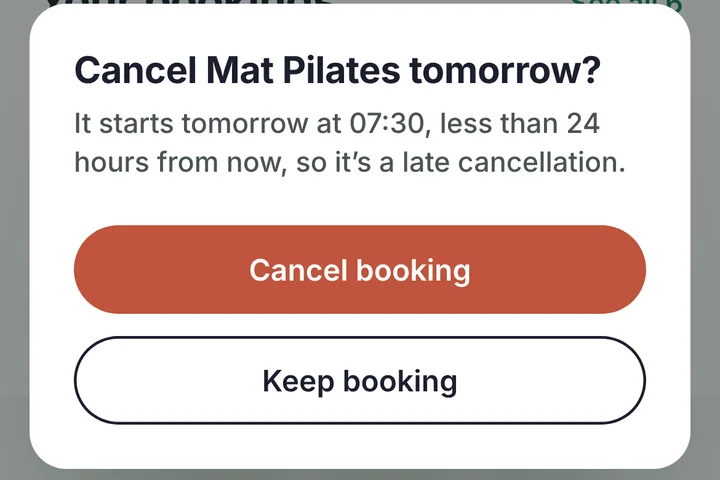
Members cancel from Your bookings on your booking page and are warned before a cancellation counts as late. Late cancellations are flagged in the record, and on a class pack the class stays used; an in-time cancellation returns it. A freed spot is offered to the waitlist straight away. By default, members also get a reminder email the evening before each class with a link to cancel, so most cancellations come in early. If you link Telegram, each cancellation alert tells you whether it was late and how many late cancellations that member has had in the last 30 days.
After a month, look at your late cancellations and no-shows. If they are rare, the policy is working, even if you have hardly had to apply it. That is the point. If one class keeps having them, look at the time of the class before you tighten the rule.